
From understanding the rules to managing or selling afterwards.
One point of contact, in Japanese and English. Transactions in the Philippines are carried out by PRC-licensed real estate brokers at our local partner in the Philippines.
* Information on this page concerns real estate located in the Republic of the Philippines. Inspire Holdings Co., Ltd. does not hold a real estate brokerage licence in Japan and does not engage in the sale, exchange, lease, or brokerage of real property located in Japan. Brokerage, sale, and lease transactions in the Philippines are carried out by PRC-licensed real estate brokers at our local partner in the Philippines. Our role is to provide information in Japanese and to connect you with our local partner in the Philippines.
* The statutes, taxes and regulatory schemes set out on this page were checked against the text of the law and materials published by the relevant authorities on 1 August 2026. They may change through amendment. Please check the official websites of the relevant authorities for the current position before you proceed or sign.
This page does not recommend properties. Its purpose is to set out, from the text of the law, what foreign nationals may and may not do under Philippine law. Below are three starting points.
The first thing to establish is what kind of real property a foreign national may acquire. Under Philippine law a foreign national cannot, as a rule, own land. Condominium units, by contrast, may be acquired within the limits the statute sets. Start with the rules, then read the steps in a purchase and the costs that arise in the Philippines.
If you intend to let the property, the question is not only whether you may acquire it, but what recurring costs you will carry and how rent is taxed in the Philippines. Association dues, sinking fund contributions, vacant periods, restoration costs, and Philippine withholding on rent all bear on what reaches you. These are set out in the costs and taxes section.
For a unit sold before completion, the questions are whether the developer holds the required permits and what protection a buyer has if handover is delayed. Philippine law provides for developer registration and a Licence to Sell, and separately protects buyers paying by instalments. Please read both what that protection covers and what it does not.
* Philippine economic indicators and statistics are published with their sources on our Philippine Economy page. This page carries no charts on property prices or forecasts.
What follows is a general explanation drawn from the 1987 Constitution of the Republic of the Philippines and the related statutes. It is not an application of those rules to any particular case. Any legal assessment of what is available to you is made by our partner law firm, qualified in the Republic of the Philippines, under a direct engagement with you.
Type/Available to a foreign national/Also to be checked
Land (bare land, and the land component of a house-and-lot)
Not as a ruleBasis1987 Constitution, Art. XII, Secs. 7 and 2
A condominium unit
Yes, within limitsBasisCondominium Act (RA 4726), Sec. 5
Land held by a corporation at least 60% Philippine-owned
Available as a matter of lawBasisConstitution, Art. XII, Secs. 2 and 7
Long-term lease (by a foreign investor meeting the requirements of RA 7652)
Available as a matter of lawBasisInvestors' Lease Act (RA 7652), Secs. 3–6
Former Philippine nationals (natural-born citizens who lost their citizenship)
Yes, within area limitsBasisConstitution, Art. XII, Sec. 8 / BP Blg. 185, Secs. 1–3 / RA 8179, Sec. 5
Those who have reacquired citizenship under RA 9225
Treated as Philippine nationalsBasisRA 9225
Acquisition by succession
A constitutional exceptionBasisConstitution, Art. XII, Sec. 7
* Any legal assessment of what is available in your particular case, and any consideration of a specific route, is made by our partner law firm, qualified in the Republic of the Philippines, under a direct engagement with you. We provide information on the framework and on the documents required.
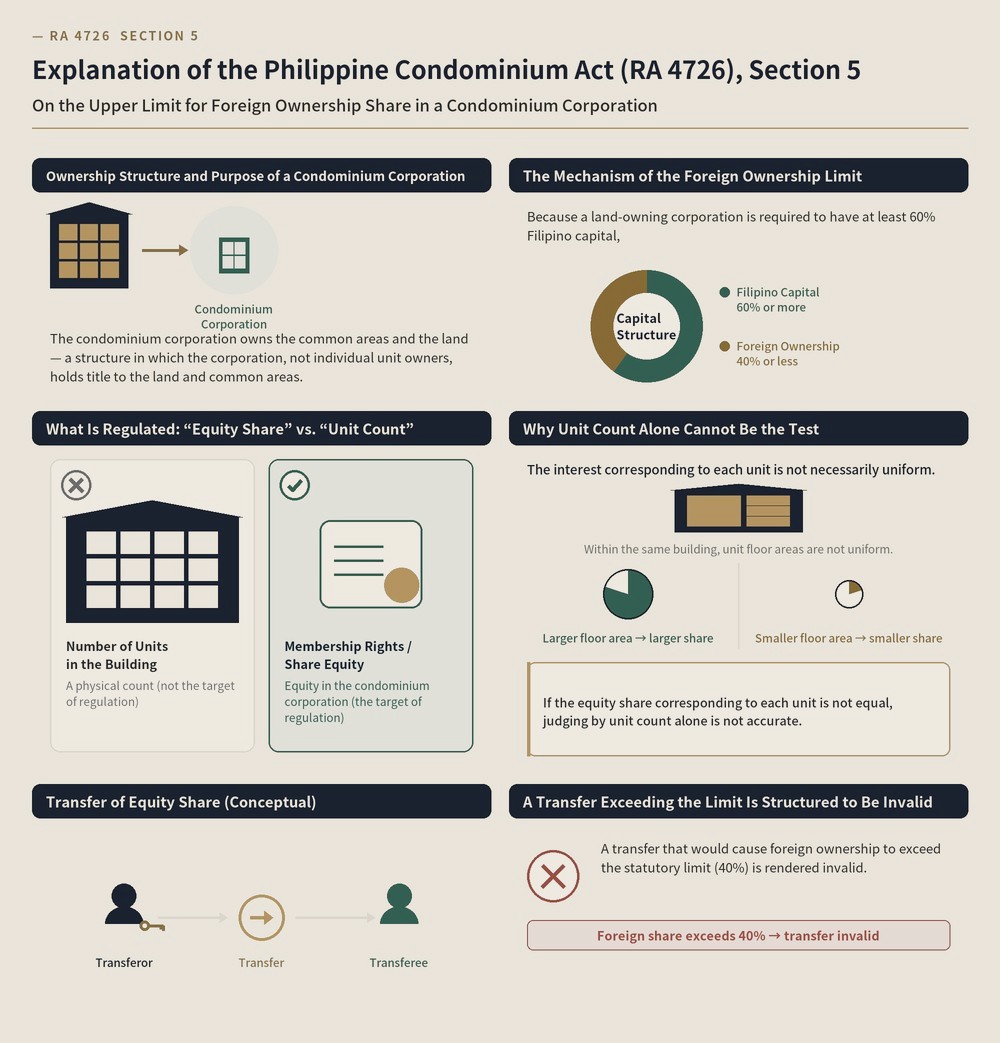
Where the common areas and the land are held by a condominium corporation, Sec. 5 of RA 4726 renders a transfer void if the accompanying transfer of membership or shares in that corporation would cause foreign interest to exceed the ceiling set by the existing law. Because a landholding corporation must be at least 60% Philippine-owned, the ceiling on foreign interest is ordinarily 40%.
The limit therefore attaches not to the physical count of units in a building, but to the foreign-held membership and shareholding in the condominium corporation established for that project. Where the interest corresponding to each unit is not uniform, counting units alone does not give the right answer.
* The bar above shows the ceiling set by RA 4726. The headroom remaining differs from project to project.
* The diagram scrolls horizontally.
The headroom remaining under the foreign ceiling differs from project to project.
* Whether headroom remains for the project you are looking at has to be checked for that project. It is not a question that can be answered in general terms.
* What is examined is the master deed, the declaration of restrictions, and the schedule allocating shares or membership.
* Where the foreign ceiling for a project has already been reached, a unit in it cannot be acquired. Once you have a project in mind, please ask us to have the headroom checked. The check is carried out by PRC-licensed real estate brokers at our local partner in the Philippines and by our partner law firm.
We do not provide information on, or assist with, in any form, any framework under which a Philippine national's name is used so that a foreign national holds real property beneficially.
Such frameworks are prohibited under Philippine law (the Anti-Dummy Act, Commonwealth Act No. 108). The Act penalises, among others: a Philippine national who permits the use of their name or citizenship by a person not qualified to hold the right; the foreign national who uses that name or citizenship; the simulation of the minimum capital required to be held by Philippine nationals; and permitting a person not qualified to intervene in the management, operation, administration or control. Where a corporation is involved, its officers and managers are also within the scope of the penalty.
A buyer who proceeds in this way may also be left without a remedy. The Supreme Court has refused to order the return of funds put up by a foreign national for property acquired in contravention of the constitutional restriction (Muller v. Muller, G.R. No. 149615, 2006; Matthews v. Taylor, G.R. No. 164584, 2009; Beumer v. Amores, G.R. No. 195670, 2012).
The starting point is to establish what is open to you within the law. Any legal assessment of a particular case is made by our partner law firm, qualified in the Republic of the Philippines, under a direct engagement with you.
Our role is to provide information and to connect you with our local partner in the Philippines. Brokerage, sale, and lease transactions in the Philippines are carried out by PRC-licensed real estate brokers at our local partner in the Philippines. Each card states which of us does what.
We take your requirements and put together property information by area, layout and price range. The brokerage itself is carried out by PRC-licensed real estate brokers at our local partner in the Philippines.
We provide information on the character of the principal areas — BGC, Makati, Pasig — and set out the points on which they differ. Choosing an area is your decision. We do not recommend a particular area. Figures for residential prices and rents are not published on this page, because we have not confirmed their source and the terms on which they may be used (see Points for comparing areas).
We accompany you on the ground for viewings, and can also conduct viewings online. Access to the properties is coordinated by our local partner in the Philippines. Flights and accommodation are secured by you or through a travel agency. Neither we nor our local partner in the Philippines is registered as a travel business in Japan, and we do not act as agent, broker, or intermediary in relation to contracts for carriage or lodging.
The purchase is carried out by PRC-licensed real estate brokers at our local partner in the Philippines. We report on progress in Japanese and pass on your questions. We attend the signing and the closing and interpret. Drafting and review of the contract, verification of title, and registration are carried out by our partner law firm and by the relevant Philippine offices.
If you would like the property managed, we introduce you to the property management team at our local partner in the Philippines. The management contract is entered into directly between you and our local partner in the Philippines. What we produce is a monthly report in Japanese on occupancy and on rent received. Rent is received directly by you from our local partner in the Philippines, or through a financial institution you nominate. We do not hold rent, and we do not transfer funds.
If you are considering a sale, we provide information on the usual sequence and on the documents required. The brokerage on a sale is carried out by PRC-licensed real estate brokers at our local partner in the Philippines. For Philippine tax on a disposal and for receiving the proceeds, see Costs and taxes. We do not offer a view on the timing, the price, or the likelihood of a sale.
* What we charge does not depend on whether a transaction completes. Any fee for the brokerage is settled directly between you and our local partner in the Philippines; we do not receive it. Our own fee is for information and for acting as your point of contact, and is quoted individually on the basis of what you need.
* Neither we nor our local partner in the Philippines receives any referral fee, introduction fee, or revenue share from developers, financial institutions, insurers, travel agencies, or any other business. We do not rank or grade the parties we introduce. We tell you who we work with and who we can introduce you to.
* We do not hold your funds, and payments are not routed through our account. Payment of the purchase price and of the associated costs is made by you directly to the financial institution and the counterparty.
The areas we are asked about most often are BGC (Bonifacio Global City), Makati, and Pasig (including the Ortigas vicinity), all within Metro Manila. This section sets out the points on which to compare them.
#/Point/What to look at
We have not been able to confirm published primary data that compares residential condominiums in BGC, Makati and Pasig on the same definition.
* The most recent published material we were able to confirm from private research houses covers the office market, and cannot be carried across to residential sale or rental levels.
* The material that does cover residential figures dates from years past, and is not something we can present as the current level.
* The residential price indices published by the government statistics agencies cover Metro Manila as a whole, or housing by type, and are not actual levels for individual areas.
* Reports published by private research houses are not quoted here, because we have not confirmed the terms on which they may be used.
Publishing figures we cannot source would work against anyone who planned on the basis of them. When we speak with you, we will set out what we hold at that time, together with its basis.
Each step states whether it is carried out by us or by our local partner in the Philippines. Signing, closing and registration are not within what we carry out.
The label on each step to the right shows who carries that step out.
What we do. This covers the Japanese-language desk, providing information, accompanying you on the ground, interpreting, and preparing reports.
What our local partner in the Philippines does. At the same step, we handle the items above in parallel.
Carried out by our local partner, our partner law firm, or the relevant Philippine offices. We do not carry these out.
There is no charge at the consultation stage. Once we have heard your circumstances, we will set out again which step is carried out by whom.
We ask about intended use, how you are approaching budget, preferred areas, and timing. There is no charge at this stage.
We put together property information against your requirements and set out the points of comparison. You can also ask at this stage for the headroom under the foreign ceiling to be checked.
We accompany you on the ground. Where travel is difficult we conduct the viewing online. Flights and accommodation are not within what we secure.
The contract of sale and the purchase are carried out by PRC-licensed real estate brokers at our local partner in the Philippines. We attend and interpret.
Payment, verification of title, and registration with the Register of Deeds are carried out by our local partner in the Philippines, by our partner law firm, and by the relevant offices. We take no part in them.
The management contract is entered into directly between you and our local partner in the Philippines. We produce a monthly report in Japanese on occupancy and on rent received. We do not hold rent and we do not transfer funds.
* How long each stage takes depends on the type of property, the developer, the financial institution, and the state of the procedures at the relevant offices. We do not offer a view on the timing of handover or on any other outcome.
What follows is a general explanation drawn from Philippine statutes and from materials published by Philippine government agencies. For tax in Japan, see the notice below in this section. We do not carry out tax representation, prepare tax filings, or give tax consultations.
Item/Content (as far as we could confirm)
Documentary Stamp Tax (DST)
SourceNIRC Sec. 196 / BIR RMC No. 3-2014
Local transfer tax
SourceLocal Government Code, Secs. 135 and 151
Registration fees
SourceLRA published materials / LRA Circular No. 03-2024
Brokerage fee
* Which side bears which item is fixed by the contract. Contracts commonly place the tax on the disposal with the seller and documentary stamp tax, transfer tax and registration fees with the buyer, but this is not the same thing as the statutory incidence, and it can be varied by agreement. Please confirm the items and who bears them in the contract of sale before you sign.
* On a purchase from a developer, value-added tax, creditable withholding tax and other items may be built into the price, so the make-up differs from a second-hand sale between individuals.
Item/Content
Capital Gains Tax
SourceNIRC Sec. 24(D)(1) / BIR Form 1706
The base
Sourceas above
Where the property is not a capital asset
SourceBIR RMC No. 99-2023
For tax in Japan, please consult a qualified tax accountant.
We do not carry out tax representation, prepare tax filings, or give tax consultations within the meaning of Art. 2(1) of the Certified Public Tax Accountant Act. Any question of tax in Japan, including the filing and reporting obligations that fall on a Japanese resident, should be put to a qualified tax accountant. What is set out on this page is a general explanation of the tax system of the Republic of the Philippines, based on information available at the time of writing.
Tax filings in the Philippines are handled by our partner accounting firm there.
* Registration is not a scheme that makes a transfer available on demand. Any transfer remains subject to the bank's review and to the regulations in force at the time.
* We do not carry out any part of a transfer. We do not hold your funds, and nothing is routed through our account.
* How funds came in at the time of purchase can bear on how you are able to receive sale proceeds later. Please confirm the position with your bank before you buy.
No yield figures are published on this page.
* Rent levels, the time taken for a unit to be let, association dues and sinking fund contributions, restoration costs, Philippine tax and the exchange rate all vary by property, by area and by period. A figure that does not state those inputs is of no use in a comparison.
* Gross rent divided by acquisition cost, and what reaches you after costs and taxes, are two different things. Presenting the first as though it were the second is something we have decided not to do.
* We do not hold a publishable basis for such a figure — the properties covered, the method of calculation, the period, the sample size, and the origin of the information — and so we publish none.
When we speak with you, we will set out, for the property you are considering, an expected rent and the items that come off it, together with their basis. Even then, it is not a guarantee of future income.
This page does not recommend pre-selling units. It sets out the obligations Philippine law places on developers, the protection available to buyers, and where that protection stops.
Before you commit, please confirm that a Licence to Sell has been issued.
For anyone looking at a pre-selling unit, this is the check that costs least and does most. We explain in general terms what to look for and connect you with our local partner in the Philippines. Examination of the documents and verification of title are carried out by our partner law firm, under a direct engagement with you.
Note that DHSUD states that the absence of a Licence to Sell does not of itself automatically rescind a sale. Other breaches of law or of contract arising from selling without one fall to be considered separately.
Category/Content
Scope
BasisRA 6552
Where at least two years have been paid
BasisRA 6552, Sec. 3
Where less than two years have been paid
BasisRA 6552, Sec. 4
Other
BasisRA 6552, Secs. 5 and 6
The existence of the Act does not remove the uncertainty attached to buying before completion.
* It is not a statute that compensates comprehensively for construction delay. Delay falls to be considered under PD 957, under the contract, and through the HSAC procedure.
* It is not a statute under which everything paid comes back. What is returned on cancellation is the proportion set out above.
* No rental income arises until handover.
* Specifications can change, and there is credit risk on the developer.
* Beyond the Licence to Sell, please also confirm the title, any mortgage, the approved plans, the scheduled completion date, any performance bond, and the developer's record of handover on earlier projects.
Question/Answer
There is no charge for an initial discussion, and our fee is quoted individually on the basis of what you need. You do not need to have a property in mind. Tell us your requirements and what you want checked first.
* Information on this page concerns real estate located in the Republic of the Philippines. Inspire Holdings Co., Ltd. does not hold a real estate brokerage licence in Japan and does not engage in the sale, exchange, lease, or brokerage of real property located in Japan. Brokerage, sale, and lease transactions in the Philippines are carried out by PRC-licensed real estate brokers at our local partner in the Philippines. Our role is to provide information in Japanese and to connect you with our local partner in the Philippines.
* What we provide is research into, and information on, the applicable rules and on properties. We do not handle legal affairs — the giving of opinions, representation, arbitration, settlement or other legal work within the meaning of Art. 72 of the Attorney Act of Japan. Legal assessment of a particular case, verification of title, drafting and review of contracts, dealings with the authorities, and registration are carried out by our partner law firm, qualified in the Republic of the Philippines, and by the relevant Philippine offices. We receive no consideration for introducing you to that firm.
* Any framework under which a Philippine national's name is used so that a foreign national holds real property beneficially is prohibited under Philippine law (the Anti-Dummy Act), and we do not provide information on, or assist with, any such framework in any form. We provide information only on what is available within the law. Neither we nor our partners guarantee that any particular acquisition will be available to you.
* What is set out on this page in relation to tax is a general explanation of the tax system of the Republic of the Philippines, based on information available at the time of writing. We do not carry out tax representation, prepare tax filings, or give tax consultations within the meaning of Art. 2(1) of the Certified Public Tax Accountant Act of Japan. For tax in Japan, including the filing and reporting obligations that fall on a Japanese resident, please consult a qualified tax accountant. Tax filings in the Philippines are handled by our partner accounting firm there. Philippine rates and thresholds are amended frequently; please confirm the current position with the BIR and the other authorities.
* Neither we nor our local partner in the Philippines is registered as a travel business in Japan. Flights and accommodation for viewings and site visits are secured by you or through a travel agency. We do not act as agent, broker, or intermediary in relation to the supply of carriage or lodging. Where we introduce a travel agency, we receive no consideration for the introduction.
* What we charge does not depend on whether a transaction completes. Any fee for the brokerage is settled directly between you and our local partner in the Philippines; we do not receive it. Neither we nor our local partner in the Philippines receives any referral fee, introduction fee, or revenue share from developers, financial institutions, insurers, travel agencies, or any other business.
* We do not hold your funds, and nothing is routed through our account. Payment of the purchase price and associated costs, and receipt of sale proceeds and of rent, are made by you directly with the financial institution and the counterparty.
* The management contract is entered into directly between you and our local partner in the Philippines. What we produce is a monthly report in Japanese on occupancy and on rent received. Rent is received directly by you from our local partner in the Philippines, or through a financial institution you nominate. We do not hold rent, and we do not transfer funds.
* Property prices, rent levels, occupancy and exchange rates all move. We do not offer a view on future prices, rents, income or the likelihood of a sale, and we do not guarantee any of them. The headroom under the foreign ceiling, the position of the developer, and the procedures of the authorities may mean that a particular property is not available to you.
* What you tell us may be provided to our partners located in the Republic of the Philippines (our local partner in the Philippines, our partner law firm, our partner accounting firm). Where that happens, we obtain your consent in advance in accordance with Art. 28 of the Act on the Protection of Personal Information, and provide you with the name of the country, information on its personal data protection regime, and the measures taken by the recipient. See our Privacy Policy.
* Please do not enter details of your assets, bank account information, or passport numbers in the enquiry form. We will ask for what is needed when we speak with you.
* The statutes, taxes and regulatory schemes set out on this page were checked against the text of the law and materials published by the relevant authorities on 1 August 2026. They may change through amendment. Please check the official websites of the relevant authorities for the current position before you proceed or sign.
| Document | Publisher | URL | Date checked |
|---|---|---|---|
| 1987 Constitution of the Republic of the Philippines, Art. XII (Secs. 2, 7 and 8) | Supreme Court E-Library | elibrary.judiciary.gov.ph | 1 August 2026 |
| Batas Pambansa Blg. 185, Secs. 1–3 | LawPhil Project | lawphil.net | 1 August 2026 |
| Republic Act No. 8179, Secs. 4 and 5 | LawPhil Project | lawphil.net | 1 August 2026 |
| Republic Act No. 4726 (Condominium Act), Secs. 2, 4 and 5 | LawPhil Project | lawphil.net | 1 August 2026 |
| Hulst v. PR Builders (on foreign interest in a condominium) | Supreme Court E-Library | elibrary.judiciary.gov.ph | 1 August 2026 |
| Republic Act No. 7652 (Investors' Lease Act), Secs. 3–6 | LawPhil Project | lawphil.net | 1 August 2026 |
| Republic Act No. 9646 (Real Estate Service Act), Secs. 3, 12–24 and 28–31 | LawPhil Project | lawphil.net | 1 August 2026 |
| BIR RMC No. 3-2014 (quoting Sec. 196 of the Tax Code) | Bureau of Internal Revenue | bir.gov.ph | 1 August 2026 |
| BIR Form 2000 Instructions (documentary stamp tax) | Bureau of Internal Revenue | efps.bir.gov.ph | 1 August 2026 |
| Local Government Code, Sec. 135 (quoted in G.R. No. 174617) | LawPhil Project | lawphil.net | 1 August 2026 |
| LRA Circular No. 03-2024 (assessment and payment of registration fees) | Land Registration Authority | lra.gov.ph | 1 August 2026 |
| LRA Frequently Asked Questions (assessment procedure) | Land Registration Authority | lra.gov.ph | 1 August 2026 |
| Republic Act No. 12214 (amending Sec. 25(B) of the Tax Code) | LawPhil Project | lawphil.net | 1 August 2026 |
| BIR RMC No. 99-2023 (capital assets and ordinary assets) | Bureau of Internal Revenue | bir.gov.ph | 1 August 2026 |
| BIR RMC No. 38-2024 (Digest) | Bureau of Internal Revenue | bir.gov.ph | 1 August 2026 |
| Presidential Decree No. 957, Secs. 4, 5, 18, 20 and 23 | LawPhil Project | lawphil.net | 1 August 2026 |
| Republic Act No. 6552 (Maceda Law), Secs. 3–7 | LawPhil Project | lawphil.net | 1 August 2026 |
| Requirement of a Licence to Sell — FAQs | DHSUD | dhsud.gov.ph | 1 August 2026 |
| PD 957 Revised Implementing Rules and Regulations | DHSUD | dhsud.gov.ph | 1 August 2026 |
| Buyer's Guide | DHSUD | dhsud.gov.ph | 1 August 2026 |
| Inward Foreign and Outward Investments FAQs (December 2025) | Bangko Sentral ng Pilipinas | bsp.gov.ph | 1 August 2026 |
| Foreign Exchange Regulations (FX Manual, Secs. 32, 36 and 37) | Bangko Sentral ng Pilipinas | bsp.gov.ph | 1 August 2026 |
| Doing Business in the Philippines 2026 | Board of Investments | boi.gov.ph | 1 August 2026 |
| Narra Nickel Mining and Development Corp. v. Redmont Consolidated Mines Corp., G.R. No. 195580 (Grandfather Rule) | Supreme Court E-Library | elibrary.judiciary.gov.ph | 2 August 2026 |
| Muller v. Muller, G.R. No. 149615 (2006) | Supreme Court E-Library | elibrary.judiciary.gov.ph | 2 August 2026 |
| Matthews v. Taylor, G.R. No. 164584 (2009) | Supreme Court E-Library | elibrary.judiciary.gov.ph | 2 August 2026 |
| Beumer v. Amores, G.R. No. 195670 (2012) | Supreme Court E-Library | elibrary.judiciary.gov.ph | 2 August 2026 |
