
Visas, housing, schools, healthcare — the unknowns of relocation, worked through one at a time.
One point of contact, in Japanese and English. The work on the ground in the Philippines is carried out by our local partner in the Philippines.
* The information on regulatory schemes set out on this page was checked against materials published by the relevant authorities on 1 August 2026. The content, requirements and costs of these schemes may change without notice at the discretion of those authorities. Please check the official websites of the relevant authorities for the current position before you travel or apply.
* Information on this page concerns real estate located in the Republic of the Philippines. Inspire Holdings Co., Ltd. does not hold a real estate brokerage licence in Japan and does not engage in the sale, exchange, lease, or brokerage of real property located in Japan. Brokerage, sale, and lease transactions in the Philippines are carried out by PRC-licensed real estate brokers at our local partner in the Philippines. Our role is to provide information in Japanese and to connect you with our local partner in the Philippines.
Deciding to relocate takes time. This page is built to be returned to — read the part you need, when you need it.
The questions that come up first are usually the requirements and cost of a long-stay visa, access to healthcare, and what daily life will look like. The SRRV is banded by age and deposit, and the deposit is money placed and left on deposit as a condition of the stay. The scheme and the costs that come with it are set out in the same table, so you can see both together.
The school, the neighbourhood, and the journey between them cannot be decided separately. This page sets out the points to check when looking at schools, and how the areas differ. Individual school names and fees are not published here, because we have not confirmed permission to publish them. We will share what we hold when we speak with you.
Working in the Philippines involves two steps in a set order: the Alien Employment Permit from DOLE, and the 9(g) visa from the Bureau of Immigration. Alongside that, procedures remain in Japan covering residence registration, pension, health insurance, and tax. Both sequences are set out here, with the office to ask in each case.
What follows is a general explanation compiled from materials published by the relevant Philippine authorities (PRA, BI, DOLE and BOI). It is not an application of those rules to any particular case.
| Visa | Who it is for | Principal requirements (as far as we could confirm) | Duration and structure | Authority |
|---|---|---|---|---|
| SRRV Classic | Those staying in the Philippines long term | The principal applicant must be 40 or over. A deposit is required, banded by age (40–49 / 50 and over) and by whether the applicant is a Pensioner or a Non-Pensioner (see tables below). For Pensioners, the pension evidence requirement is a monthly USD 800 or more for a single applicant, and USD 1,000 or more where family members are included | A long-stay scheme for retirees. PRA states that SRRV holders are exempt from the ACR I-Card and from the BI Annual Report | PRA (Philippine Retirement Authority) |
| SRRV Courtesy | As above (there are separate bands for foreign nationals and for former Philippine nationals) | The principal applicant must be 40 or over. For foreign nationals in the 40–49 band, evidence of a pension or similar benefit of USD 1,000 or more per month is stated as an additional requirement. Please check PRA's published materials for the detail of who the option covers | As above | PRA |
| 9(g) Pre-arranged Employment Visa | Those employed by a company located in the Philippines. The employing company acts as petitioner | BI's checklist requires a copy of the Alien Employment Permit (AEP) issued by DOLE, so the usual sequence is AEP first, then the 9(g). Where work begins before the AEP and 9(g) have been issued, BI's Provisional Work Permit is separately required | Initial validity and renewal are each one, two or three years, according to the employment contract. The AEP runs for one year as a rule, and may be shorter or longer according to the employment contract, but not more than three years (DOLE Department Order No. 248, s. 2025, effective 10 February 2025) | BI (9(g)) / DOLE (AEP) |
| 13(a) Immigrant Visa by Marriage | Those married to a Philippine national | The principal requirements set out by BI are: (i) a valid marriage to a Philippine national; (ii) that the marriage is valid under Philippine law; (iii) no derogatory record with law enforcement agencies at home or abroad; (iv) not suffering from a dangerous, contagious or loathsome disease; (v) sufficient means to support the family and not become a public charge; and (vi) lawful entry into and stay in the Philippines. Reciprocity — that the applicant's country grants Philippine nationals equivalent permanent residence and immigration rights — is stated as a condition of the visa being available | Applied for first on a Probationary basis, with a further procedure available for conversion to Permanent | BI |
| SIRV (Special Investor's Resident Visa) | Those with the intention and the means to invest in the activities the scheme covers | A minimum investment of USD 75,000. The applicant must as a rule be 21 or over. The investments the scheme covers are those in economic activities set out in Book V of Executive Order No. 226 (the Omnibus Investments Code) | A Probationary Multiple Entry SIRV valid for six months is issued first; once converted into an investment the scheme covers, it moves to an SIRV permitting indefinite stay for as long as the requirements continue to be met | Reviewed and endorsed by the BOI; issued by the BI |
* Which visa category applies to you depends on your own circumstances. Please confirm the specifics with our partner law firm in the Philippines.
| Age | Category | Required deposit |
|---|---|---|
| 40–49 | Pensioner | USD 25,000 |
| 40–49 | Non-Pensioner | USD 50,000 |
| 50 and over | Pensioner | USD 15,000 |
| 50 and over | Non-Pensioner | USD 30,000 |
| Applicant | Age | Category | Required deposit |
|---|---|---|---|
| Foreign national | 40–49 | Pensioner | USD 3,000 |
| Foreign national | 40–49 | Non-Pensioner | USD 6,000 |
| Foreign national | 50 and over | No category shown | USD 1,500 |
| Former Philippine national | 40–49 | — | USD 3,000 |
| Former Philippine national | 50 and over | — | USD 1,500 |
| Item | Applies to | Amount |
|---|---|---|
| Application processing fee | Principal applicant | USD 1,500 |
| Application processing fee | Each dependent applicant | USD 300 |
| Annual dues (Classic) | Principal applicant plus up to two dependents | USD 360 |
| Annual dues (Classic) | Each dependent beyond two | Additional USD 100 |
| Annual dues (Courtesy, foreign national) | Principal applicant plus up to two dependents | USD 100 |
| Annual dues (Courtesy, foreign national) | Each dependent beyond two | Additional USD 10 |
| Annual dues (Courtesy, former Philippine national) | Principal applicant plus up to two dependents | USD 50 |
| Annual dues (Courtesy, former Philippine national) | Each dependent beyond two | Additional USD 10 |
Points to weigh on deposits and costs before anything else.
・The deposit is not a fee but money placed on deposit — and it stays on deposit as a condition of the stay. Please do not plan around it as funds you can draw on for living expenses.
・The processing fee is stated to be non-refundable, including where an application is discontinued.
・Annual dues recur every year, and the amount varies with the number of dependents.
・Bank charges, notarisation and apostille, medical examinations, and police clearances are not included in the figures above. We have not been able to confirm those amounts, so they do not appear on this page.
・The content, requirements and costs of these schemes may change without notice at the discretion of the authorities.
The route we were able to confirm in the body of PRA's published materials is long-term lease under the SRRV Classic. For a habitable house and lot, townhouse or condominium unit, the conditions set out include a lease term of at least 25 years (renewable for a further 25 years at the lessee's option), a contract value of at least the peso equivalent of USD 50,000, conversion only after 30 days have passed from issuance of the SRRV, evaluation and approval by PRA together with an ocular inspection of the property, and payment of the deposit to the lessor in a lump sum.
* The minimum amount, the properties covered, and the current detailed conditions for conversion by purchase are not published here, as we could not confirm them in the body of a primary source. Nor could we confirm any current primary source stating that conversion is available under Courtesy or the other options. Conversion is not a mechanism by which the deposit is automatically refunded; it is subject to prior evaluation and approval by PRA.
The ACR I-Card is a biometric, microchipped identification card issued to registered foreign nationals. BI's FAQ states that it applies as a rule to foreign nationals whose stay in the Philippines exceeds 59 days, including holders of immigrant and non-immigrant visas as well as temporary visitors. Applications for the 9(g) and the 13(a) include the capture of a facial image and fingerprints and the issuance of the ACR I-Card.
PRA, however, states that SRRV holders are exempt from both the ACR I-Card and the BI Annual Report. It would therefore not be accurate to read the 59-day mark as applying to everyone without exception.
One point of contact, in Japanese and English. The work on the ground in the Philippines is carried out by our local partner in the Philippines. Legal conclusions on any specific matter are made by our partner law firm in the Philippines.
We hear your conditions — the commute, the school run, access to healthcare, the type of housing — and set out how the areas differ. Choosing the area is yours to decide. We do not put forward any one area as the right one.
We hear the conditions you have in mind and provide information on the character of each area and prevailing market levels. Introductions to properties and the lease contract procedure are carried out by PRC-licensed brokers at our local partner in the Philippines. What we do is provide information in Japanese and English and connect you with our local partner in the Philippines.
For the principal long-stay visas of the Philippines — the SRRV, 9(g), 13(a) and SIRV — we compile and set out the requirements, the costs, and the time each is likely to take. The preparation of application documents and the procedure before the Bureau of Immigration are carried out by our local partner in the Philippines, under a contract entered into directly with you. Legal conclusions on whether a category applies to your case are made by our partner law firm in the Philippines. What we do is provide information and connect you with them.
We set out the points worth checking when looking at schools: the curriculum system, language support, entry timing, and the journey to school. Individual school names and fees are not published on this page, as we have not confirmed permission to publish them; we will share what we hold when we speak with you. Application forms are completed and submitted by you.
We set out what is worth confirming before you travel: how consultations work, whether Japanese or English is spoken, and how payment is made. Individual provider names are not published on this page, as we have not confirmed permission to publish them; we will share what we hold when we speak with you. Questions of diagnosis and treatment are for the provider.
We hear which areas, properties, schools and healthcare providers you would like to see, and our local partner in the Philippines proposes where to visit and accompanies you on the ground. Note that flights and accommodation are secured by you or through a travel agency. Neither we nor our local partner in the Philippines holds a travel agency registration in Japan, and we do not act as agent, broker or intermediary in contracts for transport or accommodation. We can introduce you to a travel agency, and we receive no consideration for doing so.
* Neither we nor our local partner in the Philippines receives any consideration — referral fees, commissions or revenue share — from schools, healthcare providers, visa service providers, real estate brokers, insurers, or travel agencies. We do not describe anyone we introduce as "the best" or "recommended". We tell you, as a matter of fact, who we work with and who we can introduce.
Two areas we are asked about most often, set side by side. On matters of personal security, please refer to information published by public authorities rather than to any view of ours — links are set out below.
| Metro Manila | Cebu | |
|---|---|---|
| Standing | The capital region: government offices, corporate bases and embassies are concentrated here | The centre of the Visayas, with an international airport served by direct flights from Japan |
| Residential areas often considered | BGC (Bonifacio Global City), Makati, Pasig and others | Central Cebu City, Mactan Island and others |
| Housing | Predominantly high-rise condominiums. Facilities, building age and management standards vary by area | Condominiums, with detached houses also an option |
| Commuting and the school run | Traffic congestion weighs heavily, and the distance between home, school and work shapes daily life more than almost anything else. Please check actual journey times at the hours you would travel before settling on a property | Distances tend to be shorter than in Metro Manila, though times still vary by hour |
| Healthcare | Several large private hospitals. How consultations run, how payment is made, and what languages are spoken differ by facility, so we suggest confirming before you travel | Fewer options than Metro Manila. Specialist treatment may require travel to Metro Manila or abroad |
| Schooling | A wider choice of international schools, though entry timing and available places differ from school to school | A narrower choice. If a particular curriculum matters to you, we suggest confirming early |
| Japanese community | Comparatively more Japanese associations and Japanese-language sources of information | Smaller in scale than Metro Manila |
For information on personal security, please refer to the public authorities.
We do not evaluate personal security in any particular area. Before travelling or taking up residence, please check the Ministry of Foreign Affairs of Japan Overseas Safety website for the current travel and infectious disease advisories. Advisories are in place for some areas.
・Ministry of Foreign Affairs of Japan, Overseas Safety website: https://www.anzen.mofa.go.jp/ (checked 1 August 2026)
・Embassy of Japan in the Philippines: https://www.ph.emb-japan.go.jp/ (checked 1 August 2026)
This area guide is not a presentation of areas under a travel advisory as places to relocate to. Areas for which the Ministry of Foreign Affairs has issued a travel advisory are accordingly not included in the comparison above.
No figures appear on this page. The reason is set out below. What we offer instead is the order in which to build your own estimate.
Why there are no cost-of-living figures on this page.
Living costs move a great deal with the area, the type of housing, the size of the household, and the exchange rate. We have not assembled statistics we can cite, or a record of our own measurements, so we do not publish figures. Publishing figures without a source would work against anyone who planned around them.
When we speak with you, we will hear the conditions you have in mind and tell you what we hold at that point, together with where it comes from.
| Item | What to confirm |
|---|---|
| Housing | Term and renewal conditions, the deposit and the conditions for its return, what is included (furniture and appliances), building management, what happens during power and water outages, parking |
| Transport | Actual journey times at the hours you would travel, running costs and whether a driver is needed if you keep a car, availability of ride-hailing |
| Communications | The types of line available at the property and their speeds, the documents needed to take out a mobile contract, whether you will keep your Japanese number |
| Banking | The documents needed to open a local bank account (these differ by visa category), whether to keep accounts in Japan, and how and at what cost to remit funds |
On the movement of money.
The SRRV requires a foreign currency deposit with a bank designated by PRA. Neither we nor our local partner in the Philippines takes custody of the deposit or any other funds, and no funds are to be remitted through any account of ours. We can set out the general options for remitting funds — bank transfer, remittance services and so on — but the remittance itself is made by you, with your financial institution.
Individual school names and fees are not published on this page, as we have not confirmed permission to publish them. What follows are the points worth checking.
| # | Point | What to look at |
|---|---|---|
| 01 | Curriculum system | International Baccalaureate, US, British and others. If there is any prospect of returning to Japan, look early at how the curriculum connects to schooling there |
| 02 | Language support | Whether support is offered for students who are not native English speakers, which year groups it covers, and whether it carries an additional cost |
| 03 | Entry timing and places | When the school year begins, whether mid-year entry is possible, and whether there is a waiting list. Places differ by school and by year group |
| 04 | The journey | Travel time from home, including how it varies by hour, and the school bus route and time on board |
| 05 | How costs are made up | Beyond tuition: entry costs, facilities fees, school bus, materials and uniforms. Check too whether fees are revised annually |
| 06 | Where students go on to | Whether destinations of leavers are published, and how to verify them |
| 07 | If you leave | How costs are settled on withdrawal, and the issue of enrolment and academic records |
| What we (and our local partner in the Philippines) do | What we do not do |
|---|---|
| Set out the material for your decision in Japanese and English, along the lines above | We do not prepare or complete application documents. You complete them yourself |
| Plan school visits, with our local partner in the Philippines accompanying you on the ground | We cannot indicate the likelihood of a place being offered. Admission is decided by each school |
| Share what we hold on particular schools when we speak with you | We do not describe any school as "the best" or "recommended" |
Individual provider names are not published on this page, as we have not confirmed permission to publish them. We will share what we hold when we speak with you.
Medical costs abroad can run high, and deciding before you travel how those costs will be met matters. What follows is a general framing. We do not carry out insurance solicitation — that is, acting as agent or intermediary in the conclusion of insurance contracts.
| Point | What it covers |
|---|---|
| Scope of cover | What is covered and what is not. Dental, maternity and pre-existing conditions are treated very differently from product to product |
| Cashless treatment | Whether it works only at affiliated providers, or whether you pay first and claim afterwards |
| Pre-existing conditions | Whether cover is available, and on what terms, rests with each insurer's underwriting criteria |
| Term and renewal | Travel insurance runs for limited periods. Over a long stay, term and renewal conditions become the issue |
| Language of the help line | In an emergency, in what language, and at what hours |
| Limits and exclusions | Cover limits, the excess, and the circumstances that fall outside cover |
Travel insurance and locally issued medical insurance differ both in how cover is framed and in what is required to take them out. Which suits you turns on the length of the stay, age, health, and the make-up of the family. What we do is set out the points above. For choosing a product and taking it out, please speak with an insurer or a party authorised to carry out insurance solicitation.
We take on the role of your point of contact in Japan. Work on the ground is carried out by our local partner in the Philippines; legal conclusions on specific matters are made by our partner law firm in the Philippines. What is missing from this page is what we have not been able to confirm from a primary source. We do not fill those gaps with something that merely reads well.
We hear the timing you have in mind, the make-up of your family, any plans to work, and what is worrying you. The first consultation is free of charge.
Our local partner in the Philippines proposes where to visit — areas, properties, schools, healthcare providers — and accompanies you on the ground. Flights and accommodation are secured by you or through a travel agency.
We set out the visa requirements and the list of documents needed, in Japanese and English. The application procedure and the lease contract procedure are carried out by our local partner in the Philippines, under a contract entered into directly with you. The procedures that remain in Japan — residence registration, pension, health insurance and tax — are completed by you, with the offices listed under Procedures That Remain in Japan.
We set out the order of things after you land: the notification of residence to the embassy, handover of the property, communications and banking.
We remain your point of contact for questions that come up in daily life, and we let you know in advance when visa renewal comes around.
* We cannot commit to a timeline. A visa is issued following review by the relevant authority; PRA publishes a processing period of 30 to 45 working days for the SRRV, but the overall timeline moves a great deal with the state of the documents, the practice of the authorities, and school entry dates. Nothing here is a commitment that your life will be in place within any particular period.
A single list of what to confirm and where. What follows is a general explanation of each scheme.
* Neither we nor our local partner in the Philippines prepares or submits documents for any of the procedures below. Please prepare and submit them yourself, or instruct a qualified professional — a certified administrative procedures specialist (gyoseishoshi), a certified public tax accountant, or a certified social insurance and labour consultant. What follows is a general explanation of each scheme and is not an application of it to your circumstances.
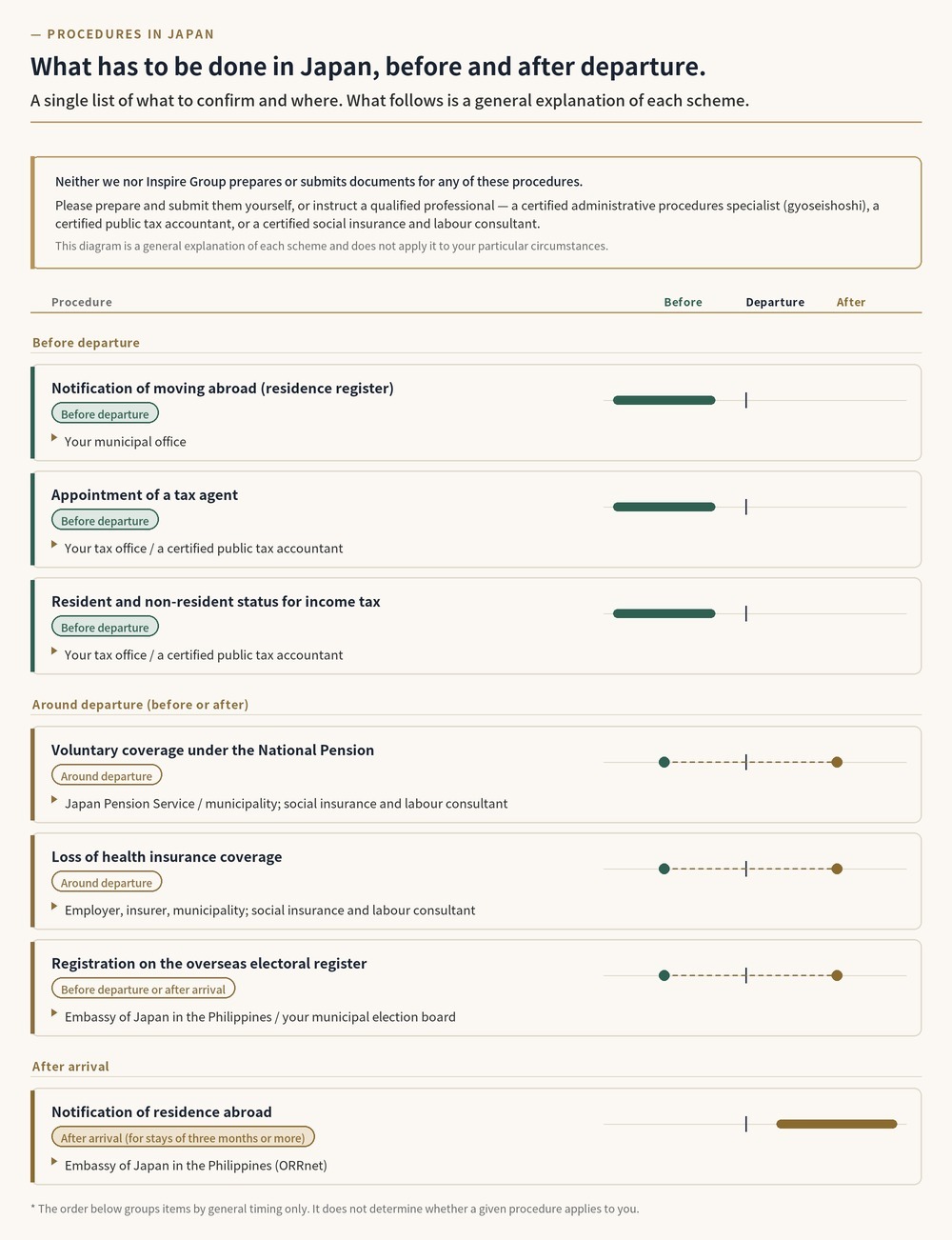
* The diagram scrolls horizontally.
| Procedure | What we were able to confirm | Timing | Where to ask |
|---|---|---|---|
| Notification of moving abroad (residence register) | Where you apply at an overseas mission to be entered on the overseas electoral register, having filed the notification of moving abroad with the municipality of your last address in Japan is a precondition. How your entry on the residence register is treated is decided by the municipality on the facts of your case. We could not find, in the materials we checked, a nationwide rule to the effect that the notification is required whenever a stay exceeds one year. | Before departure | Your municipal office |
| Voluntary coverage under the National Pension | Once you are resident abroad you cease to be a compulsorily insured person under the National Pension. Japanese nationals aged 20 to under 65 may enrol voluntarily. Before departure, the point of contact is your municipality. If you are already abroad, it is either the municipality of your last address or a Japan Pension Service office, depending on whether you have a contact person in Japan. | Around departure | Japan Pension Service / your municipality; a certified social insurance and labour consultant |
| Loss of health insurance coverage | National Health Insurance covers, as a rule, those with an address in Japan, and loss of that address on moving abroad brings loss of coverage (notification is due within 14 days as a rule). Ministry of Health, Labour and Welfare materials state that, on a move abroad, coverage ends the day after the date of departure recorded. Employees' health insurance through an employer is a separate question. | Around departure | Your employer, your insurer, your municipality; a certified social insurance and labour consultant |
| Appointment of a tax agent | For matters of taxation in Japan after departure, including an explanation of how the scheme works, please consult a certified public tax accountant or your tax office. We do not provide explanations on tax matters. | Before departure | Your tax office / a certified public tax accountant |
| Resident and non-resident status for income tax | Income tax law distinguishes residents from non-residents, and the scope of what is taxed differs between them. A resident is an individual who has an address in Japan or has had a place of abode there continuously for one year or more; everyone else is a non-resident. Which applies depends on individual circumstances. We do not provide tax consultation. | Before departure | Your tax office / a certified public tax accountant |
| Notification of residence abroad | Japanese nationals who establish an address or place of abode abroad and stay for three months or more are required, under Article 16 of the Passport Act, to file a notification of residence with the competent overseas mission. Stays of under three months fall under the Ministry of Foreign Affairs' "Tabi-Regi" registration. | After arrival (for stays of three months or more) | Embassy of Japan in the Philippines (ORRnet) |
| Registration on the overseas electoral register | For an application through an overseas mission the requirements are: being a Japanese national aged 18 or over; having resided continuously for three months or more within the same consular district; and not already being registered. An application may be made before three months have passed, with the mission confirming the address at the three-month point. Since 1 June 2018 it has also been possible to apply before departure, at the municipal office, together with the notification of moving abroad. | Before departure or after arrival | Embassy of Japan in the Philippines / your municipal election board |
Moving off the residence register and becoming a non-resident for income tax are two different things. Filing the notification of moving abroad does not itself settle how you are treated for tax. And where you are a resident of both Japan and the Philippines, the position may need to be worked through under the Japan–Philippines tax treaty. On all of this, please consult a certified public tax accountant.
"Health insurance" covers both municipal National Health Insurance and employees' health insurance through an employer. What we were able to confirm above relates mainly to loss of coverage under municipal National Health Insurance. Where an employment relationship with a company in Japan continues during an overseas posting, please confirm the position with your employer or a certified social insurance and labour consultant.
Free seminars on making a start in the Philippines, covering visas, daily life and choosing a school.
An overview of what we offer: real estate, company formation, relocation and research.
The questions we are asked most often about relocating.
How personal information is treated, including provision to third parties in other countries.
The first consultation is free of charge, and fees are quoted individually once we understand what you need. There is no need to have settled on timing. Our free relocation seminars also cover visas, daily life and choosing a school.
* We do not carry out the preparation of documents defined in Article 1-2 of the Certified Administrative Procedures Legal Specialist Act, nor any work reserved to certified public tax accountants or certified social insurance and labour consultants. Documents submitted to public offices in Japan — the notification of moving abroad, and notifications relating to pension, health insurance and tax — should be prepared and submitted by you, or by a qualified professional. Information on this page about procedures in Japan is a general explanation of the schemes concerned.
* What we provide is research into, and the supply of, information on regulatory schemes and daily life. We do not handle legal affairs within the meaning of Article 72 of the Attorney Act of Japan (appraisal, agency, arbitration, settlement, or other legal services). Legal conclusions on specific matters, the drafting and review of contracts, dealings with the authorities, and any response to a refusal are carried out by our partner law firm, qualified in the Republic of the Philippines, under a contract entered into directly with you. We receive no consideration for introductions to that firm. Visa application procedures in the Philippines are carried out by our local partner in the Philippines. We do not act as agent in an application or prepare application documents.
* A visa is issued following review by the relevant authorities of the Republic of the Philippines. Neither we nor our partners guarantee that a visa will be issued. Even where the requirements are met, an application may be refused on review. The content, requirements and costs of these schemes may also change without notice at the discretion of the authorities.
* Neither we nor our local partner in the Philippines holds a travel agency registration in Japan. Flights and accommodation for a site visit are secured by you or through a travel agency. We do not act as agent, broker or intermediary in the provision of transport or accommodation services. Where we introduce you to a travel agency, we receive no consideration for doing so.
* What you tell us may be provided to partners located in the Republic of the Philippines (our local partner in the Philippines, our partner law firm and others). Where that is the case, we obtain your consent in advance in accordance with Article 28 of the Act on the Protection of Personal Information, and set out at that time the name of the country of transfer, the personal data protection regime of that country, and the measures taken by the recipient. Please see our Privacy Policy for details.
* Please do not enter details of your health, medical history or travel history in the enquiry form. We will ask about those separately when we speak with you.
* The information on regulatory schemes set out on this page was checked against materials published by the relevant authorities on 1 August 2026. The content, requirements and costs of these schemes may change without notice at the discretion of those authorities. Please check the official websites of the relevant authorities for the current position before you travel or apply.
* Information on this page concerns real estate located in the Republic of the Philippines. Inspire Holdings Co., Ltd. does not hold a real estate brokerage licence in Japan and does not engage in the sale, exchange, lease, or brokerage of real property located in Japan. Brokerage, sale, and lease transactions in the Philippines are carried out by PRC-licensed real estate brokers at our local partner in the Philippines. Our role is to provide information in Japanese and to connect you with our local partner in the Philippines.
| Source | Publisher | Published / updated | URL | Date checked |
|---|---|---|---|---|
| EXPANDED SRRV PROGRAM (Issue No. 0001) | Philippine Retirement Authority | August 2025 | pra.gov.ph | 1 August 2026 |
| SRRVisa | Philippine Retirement Authority | — | pra.gov.ph | 1 August 2026 |
| Briefing Presentations updated as of March 2026 | Philippine Retirement Authority | March 2026 | pra.gov.ph | 1 August 2026 |
| Conversion of Visa Deposit into an Active Investment thru Long-Term Lease | Philippine Retirement Authority | October 2022 | pra.gov.ph | 1 August 2026 |
| Pre-arranged Employment Visa (9G) | Bureau of Immigration | — | immigration.gov.ph | 1 August 2026 |
| Checklist of Documentary Requirements for 9(g) Visa Issuance | Bureau of Immigration | — | immigration.gov.ph | 1 August 2026 |
| Immigrant Visa by Marriage (13A) | Bureau of Immigration | — | immigration.gov.ph | 1 August 2026 |
| FAQ's (including the ACR I-Card) | Bureau of Immigration | — | immigration.gov.ph | 1 August 2026 |
| Department Order No. 248, s. 2025 | Department of Labor and Employment | 2025 | dole.gov.ph | 1 August 2026 |
| Department Order No. 248-A, s. 2025 | Department of Labor and Employment | 2025 | dole.gov.ph | 1 August 2026 |
| Questions & Answers — Special Investor's Resident Visa Program | Board of Investments | 2023 | boi.gov.ph | 1 August 2026 |
| Voluntary enrolment in the National Pension | Japan Pension Service | — | nenkin.go.jp | 1 August 2026 |
| Joining and leaving National Health Insurance | Ministry of Health, Labour and Welfare | — | mhlw.go.jp | 1 August 2026 |
| No. 2875 Residents and non-residents | National Tax Agency | — | nta.go.jp | 1 August 2026 |
| Notifications and whereabouts enquiries (notification of residence) | Ministry of Foreign Affairs of Japan | — | mofa.go.jp | 1 August 2026 |
| Applying for the overseas electoral register via an overseas mission | Ministry of Foreign Affairs of Japan | — | mofa.go.jp | 1 August 2026 |
| Overseas Safety website | Ministry of Foreign Affairs of Japan | — | anzen.mofa.go.jp | 1 August 2026 |
